Polybasite
Jump to navigation
Jump to search

| Polybasite | |
|---|---|
)window.location='https://en.wikipedia.org/wiki/File:Polybasite-37890.jpg') | |
| General | |
| Category | Sulfosalt minerals |
| Formula (repeating unit) | [(Ag,Cu)6(Sb,As)2S7][Ag9CuS4] |
| IMA symbol | Plb[1] |
| Strunz classification | 2.GB.15 |
| Crystal system | Monoclinic and trigonal polytypes |
| Crystal class | Prismatic (2/m) (same H-M symbol) |
| Space group | C2/c |
| Identification | |
| Colour | steel black |
| Cleavage | poor on (001) |
| Fracture | uneven |
| Mohs scale hardness | 1.5-2 |
| Lustre | metallic, adamantine or glimmering |
| Streak | black with reddish tint |
| Specific gravity | 6-6.2 |
| References | [2][3][4][5] |
Polybasite is a sulfosalt mineral of silver, copper, antimony and arsenic. Its chemical formula is [(Ag,Cu)6(Sb,As)2S7][Ag9CuS4].
It forms black monoclinic crystals (thin, tabular, with six corners) which can show dark red internal reflections. It has a Mohs hardness of 2.5 to 3. It is found worldwide and is an ore of silver. The name comes from the number of base metals in the mineral.
Images[edit]
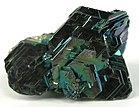
Unusual polybasite specimen from Mayo Mining District, Yukon Territory, Canada.
)window.location='https://en.wikipedia.org/wiki/File:Polybasite-tmu16a.jpg')
References[edit]
- ^ Warr, L.N. (2021). "IMA–CNMNC approved mineral symbols". Mineralogical Magazine. 85: 291–320.
- ^ Polybasite: mindat.org
- ^ Webmineral.com
- ^ Handbook of Mineralogy
- ^ Rudolf Dǔd'a and Luboš Rejl (1990). Minerals of the World. Arch Cape Press. p. 40. ISBN 0-517-68030-0.
 |
Wikimedia Commons has media related to Polybasite. |
)window.location='https://en.wikipedia.org/wiki/File:Sphalerite-221270.jpg') | This article about a specific sulfide mineral is a stub. You can help Wikipedia by expanding it. |